
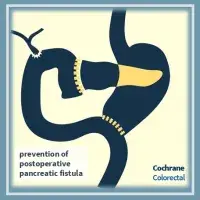
An updated Cochrane review has evaluated the benefits and harms of duct‐to‐mucosa pancreaticojejunostomy versus other types of pancreaticojejunostomy for the reconstruction of pancreatic digestive continuity in people undergoing pancreaticoduodenectomy. The review only included randomized controlled trials.
Main results:
In total, 14 randomized controlled trials with a total of 2140 adult participants undergoing open pancreaticoduodenectomy were included. All studies were at overall high risk of bias.
Duct‐to‐mucosa versus any other type of pancreaticojejunostomy
Duct‐to‐mucosa pancreaticojejunostomy compared with invagination pancreaticojejunostomy may have little to no effect on the rate of postoperative pancreatic fistula grade B or C, postoperative mortality, rate of surgical re‐intervention, rate of postoperative bleeding, overall rate of surgical complications, and length of hospital stay, but the evidence is very uncertain.
One type of duct‐to‐mucosa pancreaticojejunostomy versus another type of duct‐to‐mucosa pancreaticojejunostomy
Duct‐to‐mucosa pancreaticojejunostomy using the modified Blumgart technique compared with duct‐to‐mucosa pancreaticojejunostomy using the traditional interrupted technique may have little to no effect on the rate of postoperative pancreatic fistula, postoperative mortality, rate of adverse events, rate of surgical re‐intervention, rate of postoperative bleeding, overall rate of surgical complications, but the evidence is very uncertain.
Authors' conclusions
The benefit of duct‐to‐mucosa pancreaticojejunostomy over other types of pancreaticojejunostomy remains unclear. From a clinical perspective, there is no high‐certainty evidence of one type of duct‐to‐mucosa pancreaticojejunostomy being superior to other types of pancreaticojejunostomy, and hence surgeons should use their preferred techniques. Patients must be informed regarding this uncertainty and the experience of surgeons in the different methods, and be involved in decision‐making.
Access the publication here: https://doi.org/10.1002/14651858.CD013462.pub3
Congratulations to the authors: Xinglang Wu, Lin Hu, Shiyi Zhou, Zuojin Liu, Jianping Gong, Yilei Deng, and Yao Cheng